



With Several Thousands in Camps, We Need to Ensure That Relief Reaches Manipur
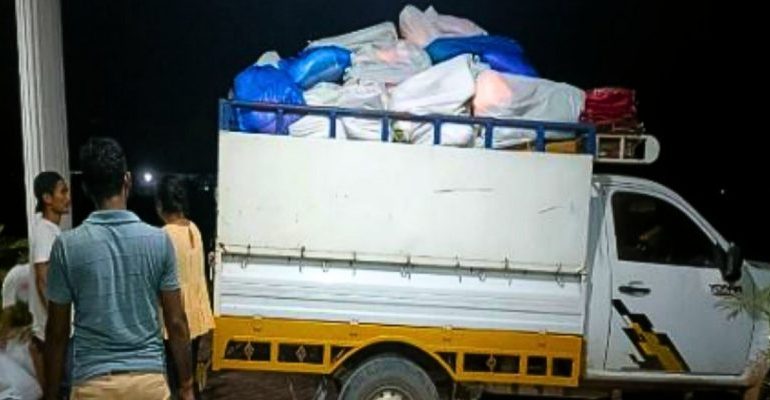

For those familiar with the intricacies of the provision of disaster or humanitarian relief, the need to ensure that the displaced population, living in relief camps, are provided an unbroken supply of both food and non-food items.
In many instances, relief logistics are the lifeline of any major humanitarian operation, regardless of the scale of the effort. In the Indian context, especially in past disasters and conflicts, logisticians as well as their network of vendors, vehicles, drivers, their assistants as well as repairmen were the fundamental building blocks for any relief work done by both government and civil society actors.
Due credit must be given to the overall ecosystem of humanitarian logistics in the country which is now able to bring together and integrate various types of cargo and modes of transport, to ensure that the neediest, staying the remotest of relief camps are provided basic sustenance.
It is the symbolism underlying relief that gets missed in such situations. It is the recognition that, however, far away human suffering must be mitigated. Relief convoys are nothing but a delicate thread that connect those have fled their homes and are in camps, to those who believe that their contribution, however small will alleviate their situation in even a minuscule way.
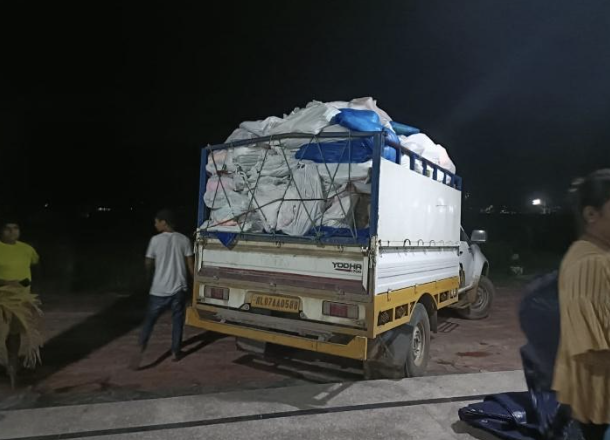
Relief vehicles of Peace Channel Nagaland on their way to Manipur.
Statistics from the conflict-affected areas in Manipur are indicative of the imperative for ensuring a well-functioning supply chain.
Based on figures provided in June, within Manipur itself, there were an upward of 50,000 people spread across 349 camps. The state of Mizoram is currently hosting an upward of 12,000 people, while in Assam and Nagaland cumulatively 3,000 people are taking refuge. The overall relief aid system in Manipur is a complex mix of external and locally based community-led assistance.
Also read: Medicine Shortages, Uncertain Educational Futures: Manipur Is Reeling Under Many Impacts of Violence
What is making the intensity of the crisis most problematic is the severe strain created by blockades and direct attacks on vehicles transporting essential items. While the closure of arterial highways has occurred in the past, the blocking of relief material, is occurring at a scale that has not been witnessed in past conflicts in the region.
There have been instances of seizure of relief supplies and this is one the most serious indicators of the situation. Further, the blockades and insecurity have reportedly led to two border districts (i.e. Tengnoupal and Chandel) being dependent on Myanmar for their sustenance.
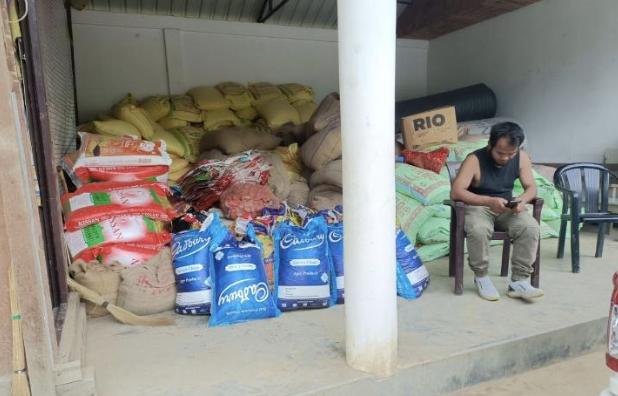
Relief material. Photo Peace Channel Nagaland.
Any attack on a truck carrying supplies for instance creates a cascading series of invisible impacts right down to the intended beneficiary. It consequently means a worsening of the situation for people living in the affected areas.
It must be remembered that those driving the trucks are themselves economically vulnerable. They are taking huge risks by driving in a conflict zone without adequate means of social and financial support. Abduction, injury or death in the line of duty is therefore catastrophic for the drivers, their assistants and families.
An idea of the seriousness of the situation can be gleaned by a few key incidents reported locally through May and June (which were captured through a local media monitoring project). It is important to note that the blocking of relief materials provided by humanitarian organisations is not captured in these reports. Nonetheless, the extent to which aid is being obstructed locally, especially by communities enforcing informal blockades around the foot-hills is a cause for alarm.
- In early May approximately 100 trucks which were to bring in essential commodities to Manipur were stranded at Noney along the Imphal-Jiribam road due to the curfew.
- Around mid-May over 200 goods trucks carrying essential commodities (including medicines) were stranded along the Imphal-Dimapur highway, due to the blockade in Kangkpoki.
- At around the same time 26 trucks carrying medicines (including life-saving drugs) were stranded in Assam and Manipur. By then the state’s stock of medicines and life-saving drugs had fallen below 60%.
- Two individuals who had taken a truck for repair were abducted at Charhajare.
- On May 21, a convoy of 243 trucks (including 74 fuel tankers) moving along the Imphal-Jiribam road under security escort was attacked. A driver of an oil tanker sustained head injuries and 13 vehicles (8 trucks eight and 5 oil tankers) were damaged with windshields broken. At the same time another 100 trucks were stranded in Senapati due to the blockade along Kangkpoki.
- On 9th June a truck carrying rice was attacked by a mob at Singjamei Chirom Leikai. The driver(who was a non-local) was assaulted and robbed of his mobile phone and cash.
- On June 13, women’s community group burnt down a truck in Heirangoithong.
- On June 15, the Silchar Truck Drivers Association refused to ply their trucks carrying essential items into Manipur as a result of continuous attacks on the Imphal-Jiribam road.
- On June 15 four trucks carrying edible items bound towards Moreh (on the India-Myanmar border) were seized by community members at Langathel and the seized edibles were re-distributed in relief camps.
- On June 18, women community members at Yairipok Khoirom Mathak Leilai seized a truck carrying clothes towards Moreh and burnt more than 200 bags of clothing.
The psychological damage inflicted on the communities by cutting aid should not be underestimated.
Not all violent actors obstruct the transportation of supplies. There is always room for some preservation of humanitarian norms, which has existed in the past.

Women and a child at the Kakching school camp at Kerirak, Manipur. Photo: Yaqut Ali, The Wire
Knowing the past matters
It is interesting to note that at the time of insurgency in Manipur in the early 1990s there was an instance that one of the authors can recall where a major underground group operating in Chandel refrained from attacking a monthly supply convoy that carried letters for troops and food supplies to an isolated border outpost on the Indo-Myanmar frontier.
The group planned ambushes on the troops or vehicles of the unit at other times. Nonetheless, they were fully aware that the convoy would run on a particular day in the month. However, it was only for that one day that they ceased attacks, especially as they knew letters were the only source of communication for the soldiers and their loved ones.
These local level arrangements tend to get overlooked due to the overarching pervasiveness of violence. Endogenously driven efforts at conflict resolution that were made to alleviate the blockade in the current crisis, unfortunately collapsed in the face of attacks by armed actors.
Also read: Manipur: Across Relief Camps, Divided Survivors Are United by the Same Anger Towards the Govt
Thus, on June 5, the Committee On Tribal Unity (COTU) Kangkpoki had announced the relaxation of the blockade on National Highway 2 into Imphal for seven days. However, by June 9, COTU reimposed the blockade in the aftermath of the Khoken killings. In the incident, unknown gunmen in military gear and travelling in a convoy of unmarked vehicles, arrived at Khoken village in Kangkpoki at around 4 am and killed three people, aged 70, 50 and 40, while injuring another two individuals aged 45 and 20. In what can only be seen as a provocation and false-flag attack a possible channel of peace was closed.
The cumulative consequences of these developments are extremely serious. They tend to get ignored in the broader discussions on the conflict in the media.
In an information-rich and evidence-poor environment, empirical micro-level solutions barely get any attention. Thus, increasing food prices and rising costs of essential commodities are a measurable source of grievance which is acutely felt. These burdens are especially conducive for setting the preconditions for further mobilisation and participation in violent acts over the medium and long-term. It is extremely difficult to build data on the exact conditions and indicators within camps, but there is some amount of impact given the artificial barriers placed by the conflict on aid distribution channels.
A person who experienced these challenges firsthand but did not wish to be named, said, “Sufficient aid and relief materials are coming in but the victims can’t access because vehicles can’t reach to the camps due to many other factors. The relief camps we visited need urgent attention with medical help for children and women, food materials, government support system, trauma healing and counselling.”
For those involved as stakeholders in the conflict, it is important to recognise the need for dialogue, starting first with issues that are measurable. The collective misery felt by all requires working solutions.
Moreover, the solutions need not come from outside. Manipur, Nagaland, Mizoram and Assam are impacted directly or indirectly by the crisis. They have a rich tradition of reconciliation through customary practices. There is sufficient expertise within the region to be able to overcome the problem identified in this article.
Peace will therefore first travel through the movement of trucks in Manipur.
Dr. Samrat Sinha is professor, Jindal Global Law School (JGLS), O.P. Jindal Global University (JGU)-Sonipat and Visiting Researcher at the Peace Centre (Chümoukedima-Nagaland).
Professor Deepanshu Mohan, is Professor of Practice, and Director, Centre for New Economic Studies (CNES), O.P. Jindal Global University (JG).
The authors thank their co-author Fr. Dr. C.P. Anto, the Peace Channel-Nagaland and the Peace Centre (Chümoukedima-Nagaland).
All photographs are sourced from the field team of Peace Channel Nagaland providing relief to those affected by the conflict in Manipur.
The Mapping Humanitarianism Initiative (MHI) is being undertaken by the Centre for New Economics Studies (CNES) in close collaboration with Peace Centre Nagaland (PCN) located in Chümoukedima.