



Panel on ‘One Election’ to Examine if ‘Ratification by States’ Is Needed, Adhir Declines to Be on it

New Delhi: The Union government has notified an eight-member high-level committee to examine the proposition of one election simultaneously, for the union and all the states.
The most crucial point among the terms and references for the committee is “examine and recommend” if the consent of the states is required at all for the decision of simultaneous elections for Delhi and states, which has a direct bearing on them.
The section (b) of ‘Terms and References’ reads, it will also “examine and recommend, if the amendments to the Constitution would require ratification by the States.”
The committee and Adhir’s refusal
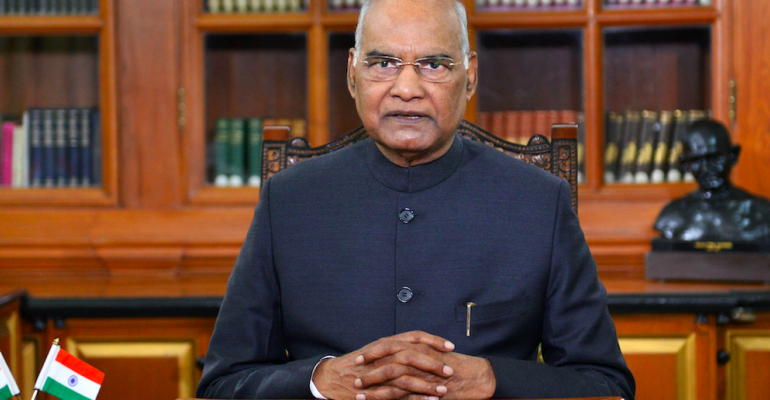
Former President of India Ram Nath Kovind was appointed as chairman of the committee. Union home minister Amit Shah, Congress MP Adhir Ranjan Chowdhury, former Rajya Sabha MP and chief minister of the erstwhile state of J&K, Ghulam Nabi Azad, former finance commission chairman N.K. Singh, former secretary general Lok Sabha Subhash C. Kashyap, senior advocate Harish Salve and former chief vigilance commissioner Sanjay Kothari are the other members.
The composition of the committee could raise eyebrows as almost all its members except Congress Parliamentary Party leader Adhir Ranjan Chowdhury are either BJP members or people who have been working with or have previously worked with the Modi government. Leaders of regional parties, who may be the most affected by simultaneous polls, have also been ignored. Former and current election commissioners, who may be the best placed to point out logistical problems with simultaneous polls, also do not figure in the committee.
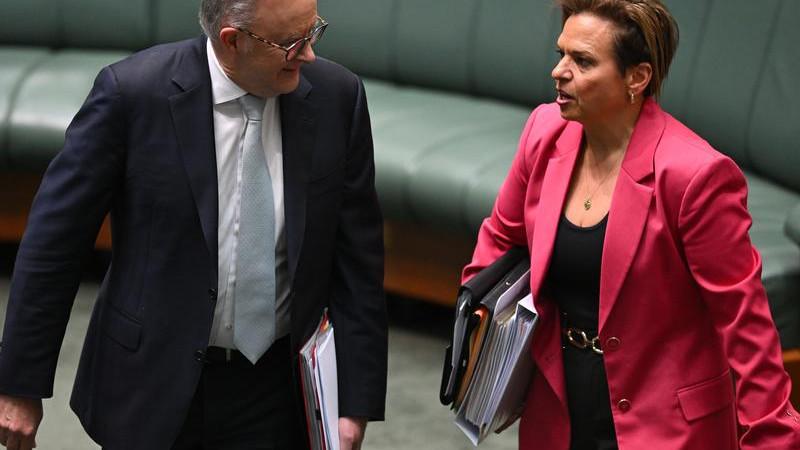
Hours after the notification, the leader of the Congress in the Lok Sabha, Adhir Ranjan Chowdhury, declined to be part of the 8-member committee, writing to Home Minister Amit Shah, saying he was of the view the exercise was a “total eyewash.” He wrote that the “terms of reference have been prepared in a manner to guarantee its conclusions”.
He termed it a “sudden attempt to thrust a constitutionally suspect, pragmatically non-feasible and logically unimplementable idea on the nation, months before the general election, raising serious concerns about the ulterior motives of the government.” He said he found “the exclusion of the current LoP from the Rajya Sabha, [Congress President, Mallikarjun Kharge] a deliberate insult to the system of Parliamentary Democracy.”
Congress’s K.C. Venugopal has posted on X (formerly Twitter) noting that the inclusion of the former Congress Rajya Sabha leader of opposition, Ghulam Nadi Azad instead of the current Congress Rajya Sabha leader of opposition Mallikarjun Kharge is a “systematic attempt to sabotage India’s parliamentary democracy.”
We believe that the High Level Committee on Simultaneous Elections is nothing but a systematic attempt to sabotage India’s parliamentary democracy.
In a shocking insult to Parliament, the BJP has appointed a former LOP to the Committee instead of Rajya Sabha LOP Sh. Mallikarjun…
— K C Venugopal (@kcvenugopalmp) September 2, 2023
The high-level committee will examine and make recommendations for holding simultaneous elections to the Lok Sabha, state legislative assemblies, municipalities and panchayats, keeping in view the existing framework under the constitution of India and other statutory provisions, and for that purpose, examine and recommend specific amendments to the constitution, the Representation of the People Act, 1950, the Representation of the People Act, 1951 and the rules made thereunder and any other law or rules which would require amendments for the purpose of holding simultaneous elections
The committee is expected to will analyse and recommend possible solutions if there are scenarios like a hung house, adoption of no-confidence motion or defection. “The committee will examine the logistics and manpower required, including EVMs, VVPATs, etc, for holding such simultaneous elections,” as per the notification.
The notification also says that law minister Arjun Ram Meghwal will attend the committee meetings as a special invitee. The committee is expected to begin functioning immediately and submit its recommendations “at the earliest”.
Observers have wondered on the appropriateness of the law ministry notifying this with Amit Shah finding a place on the committee, with Meghwal only present as a “special invitee.”
BJP’s record
The record of the Bharatiya Janata Party government, when it comes to the federal structure is questionable, with the reading down of Article 370 happening with the parliament arrogating to itself the powers vested in the (then dissolved) Jammu and Kashmir state assembly. In an unprecedented move on August 5, 2019, a state was bifurcated and demoted to a Union Territory without its views being taken into account.
Further, in the matter of Delhi, the recent Monsoon Session of the parliament witnessed storms after the government tabled a Bill in parliament for control of services and officers’ posting in Delhi, with most of the opposition parties against the Bill. This, despite the Supreme Court making clear its views on the Ordinance brought by the union government.
Article 368(2) deals with amendments to the constitution, needing ratification by states. It reads:
“Provided that if such amendment seeks to make any change in—
(a) article 54, article 55, article 73, article 162 or article 241, or
(b) Chapter IV of Part V, Chapter V of Part VI, or Chapter I of Part XI, or
(c) any of the Lists in the Seventh Schedule, or
(d) the representation of States in Parliament, or
(e) the provisions of this article,
the amendment shall also require to be ratified by the Legislatures of not less than one-half of the States by resolutions to that effect passed by those Legislatures before the Bill making provision for such amendment is presented to the President for assent.”
Note: This article has been updated since publication with news on Adhir Chowdhury’s refusal to be on it.