

Military Pomp and Defence Deals: What To Expect From PM Modi’s Visit to France
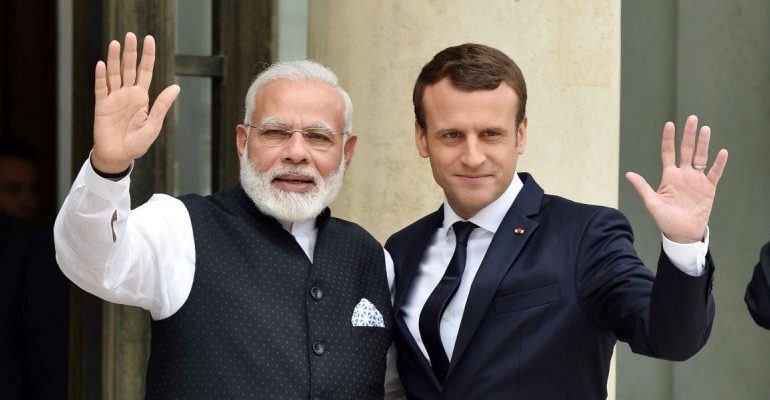

New Delhi: Indian Prime Minister Narendra Modi’s short two-day visit to France, on July 13 and 14, will be dominated by the spectacle of Indian soldiers taking part in one of the largest military parade in Europe, which will again underline that defence cooperation remains a mainstay of bilateral ties with announcements of new deals on engines, submarines and fighter jets in the pipeline.
Here is a lowdown on Modi’s visit, his appointments in Paris, as well as the geopolitical context for France’s courting of India.
What will be the Indian PM’s official schedule in Paris?
As per his current schedule, he will arrive in Paris on Friday, July 14, and take part in a dinner hosted by French President Emmanuel Macron at Louvre on the same day. As per reports, around 200 guests have been invited to the dinner. Modi will also go to the La Seine Musicale, where he will address the Indian community.
Friday is Bastille Day, commemorating the storming of the fortress-prison in Paris that marks one of the most important events in the 1789 French Revolution. Since 1880, it is marked with a military parade on the Champs-Élysées, which has seen occasional participation of foreign contingents. Indian soldiers took part in the parade in 2008, with Prime Minister Manmohan Singh in attendance. Once again, Indian PM Modi, as the guest of honour at the parade, will witness a tri-service contingent parading through the main avenue of Paris. They will also take part in a meeting with Indian and French CEOs on Friday.
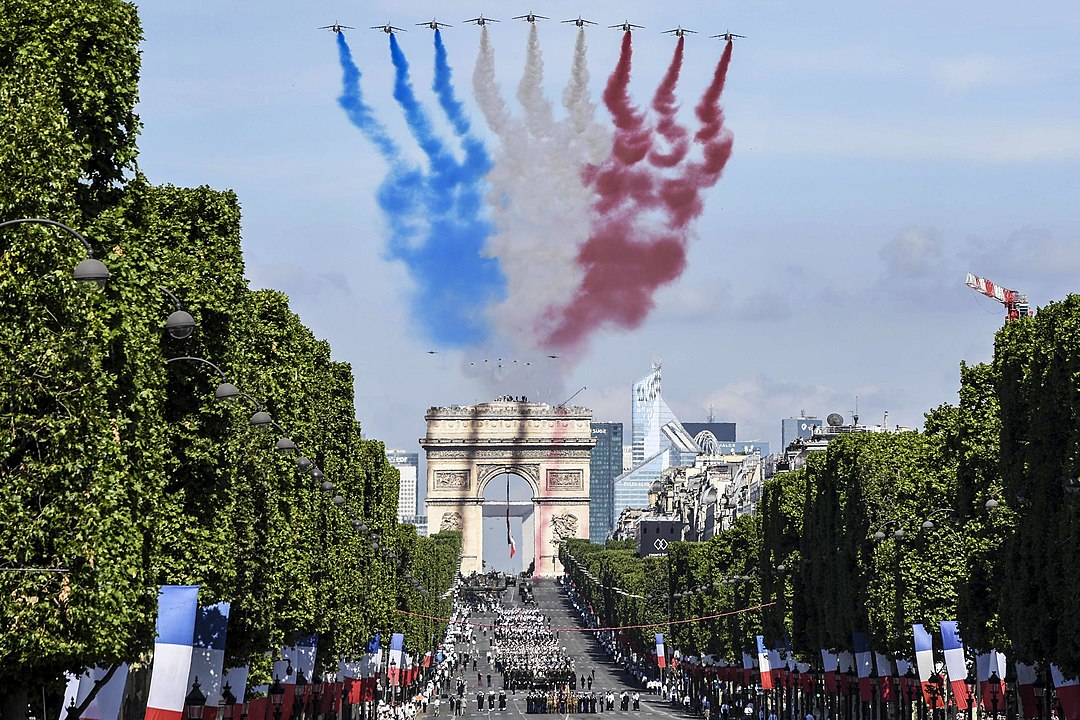
The Patrouille de France with nine Alpha Jets over the Champs-Élysées in Paris in 2017. Photo: US Navy, Chief Petty Officer Michael McNabb/Wikimedia Commons, Public Domain
What are the likely deliverables?
As was the case with his visit to the United States, Modi’s trip to France is mainly to consolidate the defence partnership.
An Economic Times report said that the highlight of the France trip would be announcements for technology transfer for the Shakti engine that powers the Indian advanced light helicopters.
This would echo a similar outcome of Modi’s US trip when an MoU was signed for the transfer of technology for GE engines for India’s indigenous fighter jet programme.
The French have subtly bristled at the hype over the projected US deal. In an interview with the Times of India, French ambassador Emmanuel Lenain said that French companies are “doing a lot of Make in India with focus on transfer of technology like no other country does”.
Further, India already has constructed six Scorpene-class submarines at Mazgaon Dockyards. But, as ET reported, the Indian Navy would also like three more of these French-origin submarines, which is urgently required as India’s ageing fleet of Russian-origin submarines get retired.
Besides, India will also be looking to procure 26 Rafale M Combat naval aircraft, which includes 22 single-seater and four double-seater trainer jets, as per Financial Express.
These three proposals have already been cleared by the Defence Procurement Board, but now require clearance from the Defence Acquisition Council, chaired by defence minister Rajnath Singh.
As per the Stockholm International Peace Research Institute (SIPRI), between 2018 and 2022, France was India’s second largest arms supplier, accounting for 29% of the country’s imports. Russia accounted for nearly half (45%) of India’s arms imports during the same period. India was the largest recipient of France’s total global arms export during the same period, with a share of 22%.
The SIPRI report also observed that French defence exports to India, which have included 62 aircraft and four submarines, have increased by 489% between 2013-17 and 2018-22. The French displaced the Americans, who trailed Russia in selling arms to India during the 2013-17 period.
Also Read: Myanmar Activists Urge Macron to Discuss With Modi India’s Sale of Weapons to Junta
Defence ties have been robust – but what about economic cooperation?
In his interviews, the French ambassador didn’t reveal the agreements that were in place but said that they would be in the sectors of defence, space, green hydrogen and people-to-people ties. Indian official sources added that there will be additional agreements in geo-strategy, infrastructure, climate action, museology, student mobility, sports and culture.
A report of the French national assembly’s foreign affairs committee this year lamented that the trade volume in “normal times” was usually around 11-12 billion euros. It increased by around 19% in 2022, as per French government figures, to around 15.1 billion euros.
This increase was reportedly due to a hike in French imports of refined petroleum products after the invasion of Ukraine by Russia. France stopped buying Russian oil after the Ukraine war. Among European nations, it was not heavily reliant on Russian energy due to its civilian nuclear energy programme. But, the partial shutdown of its nuclear plants due to problems with its main operator came at a bad time, which led to an increase in exports of energy.
Since India did not join the sanctions against Russia, Indian refiners ramped up imports of Russian crude which were then sold to the rest of the world.
In trade, the imbalance is in favour of India, with the deficit against France soaring to around 3 billion euros in 2022.
On the investment front, the story is different. French direct investment in India amounts to around 11 billion euros, with 116 companies employing 450,000 people. In contrast, Indian investment in France is valued at only 200 million euros, with fifty Indian companies employing 3,000 people.
Another area of interest for France is the negotiations for an India-European Union Free Trade Agreement. The French view seems to be while the conclusion of an FTA would help in rebalancing ties with China, it would only be acceptable if it was sufficiently ambitious. This was in contrast to India’s approach to forge an initial limited agreement that would remove tariffs on certain products that will favour Indian exporters.
How does France view India’s position in the current geopolitical situation?
The current golden period in India-France ties can be traced to the 1998 nuclear tests, when Paris was the first major power to open talks with New Delhi, which evolved into a strategic dialogue. France had also opposed imposing sanctions on India.
Incidentally, France had become the third-party supplier of fuel to the Tarapur reactor, with blessings of the United States, in the wake of sanctions triggered by India’s first nuclear test.
France often looks at India as having a similar view on strategic autonomy, with both countries balancing relations with either ‘camps’. Macron was, perhaps, the only major Western leader to have sustained a personal relationship with his Russian and Chinese counterparts. His remarks about European position vis-à-vis Taiwan, which he later clarified, were greeted by indignant objections on both sides of the Atlantic.
According to most practitioners and observers, the key strategic convergence between India and France is in the Indo-Pacific.
France considers itself an Indo-Pacific power through its overseas territories, which account for nine million square kilometres of EEZ in the region. While India’s Indo-Pacific position is based on Modi’s speech at the Shangri-La Dialogue in 2018, France unveiled its Strategy a year later which underlined the rule of law and stated that “attempts and temptations at hegemony division or confrontation must be discouraged”.
France faced a setback over the formation of AUKUS in 2021, which led Australia to scrap its $90 billion contract with France for submarines. France and Australia have since normalised their ties, but the ‘stab in the back’ had then led French strategists to opine that Paris should “fully bank on India”.
Following the signing of a logistics support agreement, Indian naval ships can make technical stops in French territories in the Indian Ocean, while French ships could do the same in Indian ports.

INS Vikramaditya at sea. Photo: Indian Navy
Will Ukraine figure in talks with India?
The Ukraine war will certainly figure during the talks, but largely to take stock of each other’s assessments. The French ambassador had said that France’s approach “is not to preach or try to put pressure”. “Foreign policy is grounded in facts and reality and each country’s foreign policy works within its constraints and interests. We have our own constraints,” he said last week.
There is a strategic divergence in how France and India view the Ukraine war. For Paris, the conflict has global dimensions, with implications for the rule of law and territorial integrity in the Indo-Pacific. “If Russia were to prevail, other countries, such as China, could take advantage of this experience to give free rein to their imperialist aspirations,” said the report of the National Assembly’s foreign affairs committee.
India, like most other developing nations, considers the Ukraine war as a European conflict, which has an economic impact on the rest of the world’s food and energy security.
The report, which was published after a visit of the committee members to India in March to meet with the Indian establishment, also believed the time was ripe for France to attempt to wean India away from Russia.
“For New Delhi, the relationship with Russia appears as a heritage, an asset but also, and increasingly, as a headache. The time is therefore well chosen to further strengthen, and over the long term, our strategic partnership with India, in the military and energy sectors, but also in economic and environmental matters, where the margins for progress are the strongest,” said the report.